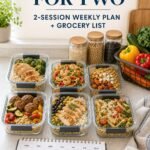
Meal prep for two works best when you plan around actual recipe yields instead of simply cutting family-size recipes in half. This guide gives two adults a weekly dinner menu, a matching grocery list, a Sunday prep session, a midweek cook, and a clear plan for leftovers.
Quick answer: Count the meals you will both eat at home, choose recipes with overlapping ingredients, assign every portion to a day, and freeze portions you will not eat within the refrigerator storage window. Start with the five-dinner plan below, then add breakfasts and lunches to suit your schedule.
In this guide
- Five dinners for two with exact recipe yields
- Sunday and Wednesday cooking schedules
- A matching grocery checklist
- Portioning, storage, and flexible meal ideas
Why meal prep for two is different
A six-serving recipe makes three dinners for two, while an eight-serving recipe makes four. You do not need to reduce every recipe: you need to decide which portions belong in the refrigerator and which belong in the freezer. A midweek cooking session keeps later meals fresh without relying on a full week of refrigerated Sunday leftovers.
A five-dinner starter plan for two
This repeat-friendly starter menu covers Monday through Friday dinner for two adults: 10 dinner portions. Cook both recipes at their published yields. The two batches produce 14 portions: eat 10 this week and freeze four chili portions for two future dinners. Breakfasts, lunches, snacks, optional toppings, and weekend meals are separate; add their ingredients to your list. If you prefer more variety, replace a two-person dinner with a meal from your freezer and freeze the displaced portions promptly.
| Dinner | What two people eat | Batch allocation |
|---|---|---|
| Monday | slow cooker teriyaki chicken bowls | 2 of 6 bowls |
| Tuesday | Teriyaki chicken bowls | 2 of 6 bowls |
| Wednesday | Teriyaki chicken bowls | Final 2 bowls; cook the chili batch today |
| Thursday | Crockpot turkey chili | 2 of 8 servings |
| Friday | Turkey chili | 2 of 8 servings |
| Weekend | Fresh meal, meal out, or a planned freezer dinner | Outside this grocery list |
Recipe yields and planned leftovers
| Recipe | Published yield | Eat this week | Freeze |
|---|---|---|---|
| slow cooker teriyaki chicken bowls | 6 bowls | 6 portions across 3 dinners | None in the base plan |
| Crockpot turkey chili | 8 servings | 4 portions across 2 dinners | 4 portions in two 2-serving packs on Wednesday |
Portion counts use the linked recipes’ published yields, not a promise that every adult will need the same amount of food. Add sides or larger portions for your appetite and adjust the shopping list. Do not halve a slow-cooker recipe without checking the appliance fill guidance and the recipe’s instructions.
Sunday prep: teriyaki chicken, rice, and broccoli
- Use thawed chicken and follow the full slow cooker teriyaki chicken bowls recipe in a 6-quart slow cooker. The recipe lists 15 minutes of prep plus 5–6 hours on LOW; this is not a 90-minute total cook. Allow additional time for finishing the sauce, rice, broccoli, and portioning.
- Near the end, cook enough rice to yield 4 cooked cups and prepare 5 cups broccoli florets. Divide the chicken, rice, and broccoli into six equal portions. Keep broccoli separate if you prefer a firmer texture.
- Label two portions for Monday, two for Tuesday, and two for Wednesday. Refrigerate promptly in shallow containers and finish within 3–4 days of cooking. Freeze the sauced chicken earlier if your schedule changes; make fresh rice and broccoli for that later meal.
Wednesday prep: turkey chili for dinner and the freezer
- Start the full Crockpot turkey chili recipe early enough for its cook time: about 20 minutes prep plus 6–7 hours on LOW, or the recipe’s 3–4 hours on HIGH. Brown the turkey and move it straight into the cooking process. This is a second cooking session, not a 45-minute finished dinner.
- Use a food thermometer to check the poultry reaches 165°F. Divide the finished batch into eight servings. Refrigerate four for Thursday and Friday; promptly cool and freeze the other four without toppings in two 2-serving packs.
- Label freezer packs with the recipe, cooking date, and “2 servings.” The recipe recommends up to 3 months frozen for best quality. Reheat in a microwave or on the stovetop to 165°F.
- Buy the raw turkey near Wednesday, or freeze it promptly after shopping and thaw it in the refrigerator before cooking. Do not hold raw ground turkey in the fridge from Sunday until Wednesday.
One slow cooker is enough because the batches are cooked on different days. Check that its capacity and fill instructions match the recipes. For smaller freezer-friendly options, browse freezer meals for two.
The matching grocery list
For the two complete recipe batches, the main purchases are 2 pounds chicken, 2 pounds ground turkey, 5 cups broccoli florets, rice yielding 4 cooked cups, three 15-ounce cans of beans, and two cans of tomatoes, plus aromatics and the measured sauce and spice ingredients. Garlic is shared: four cloves per recipe, eight cloves total.
Use the meal prep grocery list for two with exact recipe quantities for the complete checklist and pantry audit. It includes the four freezer portions; it does not claim to cover every meal for seven days.
How to portion meal prep for two
Start with the number of eating occasions, not the number of recipes.
If both people need lunch at home for three days, that is six lunch portions. One four-serving dinner can cover dinner for two plus lunch for two the next day. It does not cover the whole workweek.
Use this simple calculation:
People × meals eaten at home × portions per meal = portions required
Then subtract restaurant meals, planned takeout, workplace lunches, and existing freezer portions. This small step prevents buying for an imaginary perfect week.
Portions do not need to be identical. If one person needs a larger meal, store the protein, grain, and vegetables separately and assemble by appetite. The USDA MyPlate model can help you think in food groups, but individual energy and medical needs vary. A registered dietitian can provide individualized guidance.
Five formulas that keep the week flexible
These are assembly formulas, not tested recipes.
1. Grain bowl
Combine a cooked grain, protein, two vegetables, a sauce, and a crunchy topping. Keep the sauce separate until serving.
2. Wrap
Layer a tortilla with a spread, cooked protein or beans, crunchy vegetables, and greens. Assemble the night before rather than several days ahead to avoid sogginess.
3. Big salad
Use sturdy greens, raw and roasted vegetables, a protein, and a high-texture topping. Store dressing separately.
4. Fast skillet
Reheat cooked grain and vegetables in a hot skillet, then add a fresh egg, beans, or properly reheated cooked meat. Finish with sauce.
5. Freezer rescue dinner
Pair one two-serving frozen main with a fast vegetable or salad. The goal is not to freeze the whole week; it is to have one meal available when plans collapse. See the small-batch freezer meals for two guide.
Food-safety rules that shape the plan
Keep cold food at 40°F or below and refrigerate perishables within two hours—one hour when the surrounding temperature is above 90°F. Divide large batches into shallow containers so they cool more quickly.
USDA guidance says most cooked leftovers can be refrigerated for three to four days. Reheat leftovers to 165°F. Poultry and casseroles should also reach 165°F when initially cooked; consult the current FoodSafety.gov chart for other foods.
Use dates as a planning aid, but discard food sooner if it was mishandled or you are unsure how long it sat out. Smell and appearance cannot prove that food is safe.
How to reduce waste in a two-person kitchen
Plan one flexible meal
Leave Saturday dinner or Sunday lunch open. That slot absorbs leftovers, a meal invitation, or produce that needs using.
Buy ingredients with more than one job
Choose spinach for egg bake, wraps, and salad; use roasted peppers in bowls and pasta; turn yogurt into breakfast and sauce. Ingredient overlap should feel intentional, not repetitive.
Freeze early, not on the edge
If you know a four-serving recipe will not be finished within three to four days, freeze two portions soon after cooling. Label the package with the name, date, and reheating note.
Keep a “use first” box
Place open produce, half-used herbs, and near-term leftovers together at eye level. Check it before choosing a snack or starting dinner.
Track what came home
If both people repeatedly bring prepared lunches home uneaten, reduce next week’s lunch count. A plan should match actual behavior.
When budget or protein is the priority
For a lower-cost week, begin with the budget meal plan for two, which uses overlapping ingredients and a flexible price worksheet instead of an unrealistic nationwide total.
If lunch satiety and protein variety matter more, use the high-protein meal prep for two guide. It avoids medical promises and shows how to combine food sources without forcing every meal into a body-building template.
If convenience is the deciding factor, the meal prep vs meal delivery for two comparison calculates cost per eaten serving, time, and waste rather than declaring one universal winner.
Frequently asked questions
Is meal prepping for two worth it?
It can be worthwhile when you regularly buy duplicate groceries, order last-minute takeout, or spend time deciding what to cook. Start with three lunches and two planned dinners instead of trying to prepare every bite for seven days.
How many containers do two people need?
A practical starting set is four to six single-serving containers, two larger component containers, two small sauce containers, and two freezer-safe two-serving containers. Reuse what you own before buying a new set.
Can I meal prep once for an entire week?
You can prepare freezer-friendly food for later in the week, but most cooked refrigerated leftovers should be used within three to four days. A Sunday session plus a brief Wednesday refresh usually gives better safety and texture.
How do we meal prep if we eat different portions?
Store components separately and assemble meals by appetite. You can also label larger portions or add an easy side—fruit, yogurt, bread, or salad—for the person who needs more.
What should I prep first as a beginner?
Prepare one breakfast, one versatile protein, one grain, and one tray of vegetables. That is enough to cover several meals without creating a refrigerator full of food you may not want.
The bottom line
Good meal prep for two is a small operating system: plan the meals you will actually eat, prep shared components, refresh midweek, and freeze extras early. Begin with three days, learn which portions and flavors work for your household, and expand only when the routine feels easy.
Source notes
- USDA FSIS, “Leftovers and Food Safety”: https://www.fsis.usda.gov/food-safety/safe-food-handling-and-preparation/food-safety-basics/leftovers-and-food-safety
- USDA MyPlate, “Plan Your Weekly Meals”: https://www.myplate.gov/eathealthy/budget/budget-weekly-meals
- FoodSafety.gov, “Safe Minimum Internal Temperatures”: https://www.foodsafety.gov/food-safety-charts/safe-minimum-internal-temperatures
For raw poultry handling and slow-cooker use, see USDA slow-cooker food safety and USDA food safety basics.