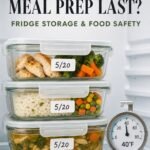
Most cooked meal-prep food should be eaten within three to four days when continuously refrigerated at 40°F or below. Refrigerate perishable food within two hours of cooking—within one hour if the surrounding temperature is above 90°F—and reheat leftovers to 165°F.
Last fact-checked: August 18, 2026.
That is why the FenRecipes meal prep for two system uses a main Sunday session and a smaller Wednesday refresh. A seven-day menu does not mean every meal should spend seven days in the refrigerator.
This guide summarizes current USDA and FoodSafety.gov recommendations. When a product label or official recall notice gives stricter instructions, follow those instructions.
Quick meal-prep storage chart
| Food or situation | Refrigerator guidance | Freezer or action |
|---|---|---|
| Most cooked leftovers | 3 to 4 days at 40°F or below | Freeze for longer storage; USDA says leftovers can generally be frozen for 3 to 4 months |
| Cooked poultry, casseroles, soups, and stews | Use the general 3-to-4-day leftover rule | Freeze promptly in meal-size portions |
| Food left at room temperature | Refrigerate within 2 hours | Discard if left longer; limit is 1 hour above 90°F |
| Large batch of hot food | Divide into shallow containers and refrigerate promptly | Do not wait for a full stockpot to cool on the counter |
| Frozen leftovers | Thaw in refrigerator, cold water, or microwave | Reheat to 165°F; cook immediately after cold-water or microwave thawing |
| Meal with an unknown preparation date | Safety window cannot be confirmed | When in doubt, throw it out |
The three-to-four-day period starts when the food is cooked, not when it is finally placed into an individual lunch box.
Why “it smells fine” is not a safety test
Spoilage organisms can create unpleasant odors, flavors, or textures, but harmful bacteria may be present without a warning you can see or smell. Do not taste questionable food to decide whether it is safe.
Time and temperature are the useful controls. Label the container with the preparation date, keep the refrigerator at 40°F or below, and discard food when its safe history is uncertain.
Cool cooked food safely
Refrigerate within two hours
Move perishable food into the refrigerator within two hours after cooking or removing it from refrigeration. When the surrounding temperature is above 90°F—such as at an outdoor picnic or in a hot car—the limit is one hour.
Use shallow containers
Divide a large batch into smaller, shallow containers. This helps food cool more quickly than leaving it in a deep pot. It is safe to put hot food directly into the refrigerator, or you can rapidly chill it in an ice or cold-water bath before refrigerating.
Do not crowd the refrigerator
Cold air needs room to circulate. Avoid packing the refrigerator so tightly after a large prep session that cooling becomes inefficient.
Label every batch
Use “cooked Aug 18” rather than only “chicken.” If you freeze the meal, add the freezing date and a brief reheating note.
A safe weekly meal-prep schedule
Sunday
Cook food for Monday through Wednesday and, if timing allows, Thursday. Freeze any planned Friday or Saturday portions once they have cooled safely.
Wednesday
Use or freeze remaining Sunday leftovers that are still within their safe window. Cook a smaller fresh batch for Thursday through Saturday.
Friday
Move a frozen two-serving meal to the refrigerator for a later meal if it can thaw safely there. Check its label and recipe-specific instructions.
This schedule is easier to manage than trying to remember whether each container came from Sunday, Monday, or Tuesday.
Reheat meal prep safely
Reheat cooked leftovers to an internal temperature of 165°F, measured with a food thermometer. Bring soups, sauces, and gravies to a rolling boil when reheating, following USDA guidance.
Microwave reheating
- Cover the food to hold moisture and encourage more even heating.
- Rotate or stir midway through heating.
- Let the food stand briefly, then check temperature in more than one place.
- Pay attention to cold centers in dense foods such as casseroles.
Oven or stovetop reheating
Use a temperature and method that reheats the food promptly and evenly. Add a small amount of liquid to rice, pasta, or a thick sauce when appropriate for texture. Confirm 165°F in the center.
USDA advises against reheating leftovers in a slow cooker because food may spend too long moving through unsafe temperatures. A slow cooker can hold already reheated food hot at 140°F or above.
Cook proteins to safe minimum temperatures
Reheating temperature does not replace safe initial cooking. Current FoodSafety.gov guidance includes:
- Poultry, including ground poultry: 165°F
- Casseroles containing meat and leftovers: 165°F
- Ground beef, pork, veal, and lamb: 160°F
- Whole cuts of beef, pork, veal, and lamb: 145°F with a three-minute rest
- Fish with fins: 145°F or until the flesh is no longer translucent and separates easily with a fork
- Egg dishes: 160°F
Check the official chart for the food you are preparing and measure at the thickest part without touching bone.
Freeze what you will not eat in time
Freezing pauses bacterial growth but does not make mishandled food safe again. Freeze planned extras while they are still within the safe refrigerated period—preferably soon after cooking and cooling—rather than waiting until day four to decide.
For best convenience:
- Package two servings together for a dinner or one serving for lunch.
- Remove excess air from freezer bags.
- Leave appropriate headspace in rigid containers when food may expand.
- Freeze sauces separately when that preserves texture.
- Add the name, date, and reheating method to the label.
USDA says frozen leftovers maintain best quality for about three to four months, although continuously frozen food can remain safe longer; quality declines over time. For small-batch meal ideas, see freezer meals for two.
Thaw leftovers safely
Use one of three safe methods:
- Refrigerator: the easiest method for planning ahead.
- Cold water: keep food in a leak-proof package and change the water as directed; cook or reheat immediately.
- Microwave: cook or reheat immediately after thawing.
Do not thaw perishable meals on the counter. Some leftovers can be reheated from frozen, but the method must heat them evenly to 165°F.
What changes the storage window?
The general three-to-four-day rule does not rescue food that was left out too long, cooled poorly, held in a warm refrigerator, or repeatedly moved between temperatures. A lunch carried to work also needs cold control—use an insulated bag with enough cold sources unless it goes directly into a refrigerator.
People who are pregnant, age 65 or older, younger than five, or immunocompromised have a higher risk of serious foodborne illness. They should follow official guidance carefully and consult a qualified clinician for individualized advice.
Frequently asked questions
Can meal prep last seven days in the fridge?
Most cooked leftovers should not be refrigerated for seven days. Use cooked refrigerated food within three to four days and freeze later-week portions or cook again midweek.
Does meal prep last longer in airtight containers?
A clean, leak-resistant container protects food and quality, but it does not extend the USDA three-to-four-day guidance for most cooked leftovers.
Can I put hot meal prep directly in the fridge?
Yes. USDA says hot food can go directly into the refrigerator. Divide large quantities into shallow containers so they cool rapidly.
Can I reheat the same meal more than once?
Reheat only the portion you plan to eat. Repeated temperature changes can reduce quality and complicate safe handling. If you reheat all leftovers and do not finish them, USDA says refrigerate the remainder immediately so it can be safely reheated again, provided all handling guidance was followed.
When should I throw meal prep away?
Discard it when it is beyond the recommended refrigerated window, sat out too long, was exposed to an unsafe refrigerator temperature, is affected by a recall, or has an uncertain history. When in doubt, throw it out.
The bottom line
Most meal prep lasts three to four days in a refrigerator at 40°F or below. Cool it promptly, store it in shallow containers, label the date, reheat leftovers to 165°F, and freeze later-week food early.
Sources
- USDA FSIS, “Leftovers and Food Safety”: https://www.fsis.usda.gov/food-safety/safe-food-handling-and-preparation/food-safety-basics/leftovers-and-food-safety
- USDA FSIS, “Steps to Keep Food Safe”: https://www.fsis.usda.gov/food-safety/safe-food-handling-and-preparation/food-safety-basics/steps-keep-food-safe
- FoodSafety.gov, “Safe Minimum Internal Temperatures”: https://www.foodsafety.gov/food-safety-charts/safe-minimum-internal-temperatures